The purpose of Relief Society is to help prepare women for the blessings of eternal life as they increase faith in Heavenly Father and Jesus Christ and His Atonement. To strengthen individuals, families, and homes through ordinances and covenants. To work in unity to help those in need.

This blog was created for the Woodland Hills Ward Relief Society sisters. It's purpose is to share information, unite and help each sister grow closer to Jesus Christ. This is not an official site of the LDS Church, and the opinions and statements are not representative of the church as a whole.

Sunday, June 10, 2018

Lesson Recap: June 10, 2018


"With One Accord"
Sister Reyna Aburto


In order to reach our sublime destiny, we need each other, and we need to be unified.

One of the most remarkable creatures on earth is the monarch butterfly. On a trip to Mexico to spend Christmas with my husband’s family, we visited a butterfly sanctuary, where millions of monarch butterflies spend the winter. It was fascinating to see such an impressive sight and for us to reflect on the example of unity and obedience to divine laws that God’s creations demonstrate.1

Monarch butterflies are master navigators. They use the sun’s position to find the direction they need to go. Every spring, they travel thousands of miles from Mexico to Canada, and every fall, they return to the same sacred fir forests in Mexico.2 They do this year after year, one tiny wing flap at a time. During their journey, they cluster together at night on trees to protect themselves from the cold and from predators.3

A group of butterflies is called a kaleidoscope.4 Isn’t that a beautiful image? Each butterfly in a kaleidoscope is unique and different, yet these seemingly fragile creatures have been designed by a loving Creator with the ability to survive, travel, multiply, and disseminate life as they go from one flower to the next, spreading pollen. And although each butterfly is different, they work together to make the world a more beautiful and fruitful place.
Like the monarch butterflies, we are on a journey back to our heavenly home, where we will reunite with our Heavenly Parents.5Like the butterflies, we have been given divine attributes that allow us to navigate through life, in order to “[fill] the measure of [our] creation.”6 Like them, if we knit our hearts together,7 the Lord will protect us “as a hen [gathers] her chickens under her wings”8 and will make us into a beautiful kaleidoscope.
Girls and boys, young women and young men, sisters and brothers, we are on this journey together. In order to reach our sublime destiny, we need each other, and we need to be unified. The Lord has commanded us, “Be one; and if ye are not one ye are not mine.”9
Jesus Christ is the ultimate example of unity with His Father. They are one in purpose, in love, and in works, with “the will of the Son being swallowed up in the will of the Father.”10
How can we follow the Lord’s perfect example of unity with His Father and be more unified with Them and with each other?
An inspiring pattern is found in Acts 1:14. We read, “[The men] all continued with one accord in prayer and supplication, with the women.”11
I think it is significant that the phrase “with one accord” appears several times in the book of Acts, where we read about what Jesus Christ’s followers did immediately after He ascended to heaven as a resurrected being, as well as the blessings they received because of their efforts. It is also significant that we find a similar pattern among the faithful of the American continent at the time the Lord visited and ministered to them. “With one accord” means in agreement, in unity, and all together.
Some of the things that the faithful Saints did in unity in both places were that they testified of Jesus Christ, studied the word of God, and ministered to each other with love.12
The Lord’s followers were one in purpose, in love, and in works. They knew who they were, they knew what they had to do, and they did it with love for God and for each other. They were part of a magnificent kaleidoscope moving forward with one accord.
Some of the blessings they received were that they were filled with the Holy Ghost, miracles took place among them, the Church grew, there was no contention among the people, and the Lord blessed them in all things.13
We can suppose that the reason why they were so united is because they knew the Lord personally. They had been close to Him, and they had been witnesses of His divine mission, of the miracles that He performed, and of His Resurrection. They saw and touched the marks in His hands and feet. They knew with certainty that He was the promised Messiah, the Redeemer of the world. They knew that “He is the source of all healing, peace, and eternal progress.”14
Even though we may not have seen our Savior with our physical eyes, we can know that He lives. As we draw closer to Him, as we seek to receive a personal witness through the Holy Ghost of His divine mission, we will have a better understanding of our purpose; the love of God will dwell in our hearts;15 we will have the determination to be one in the kaleidoscopes of our families, wards, and communities; and we will minister to each other “in newer, better ways.”16
Miracles happen when the children of God work together guided by the Spirit to reach out to others in need.
We hear so many stories of neighborly love shown among people when catastrophe strikes. For example, when the city of Houston suffered a massive flood last year, people forgot about their own needs and went to the rescue. An elders quorum president sent a call for help to the community, and a fleet of 77 boats was quickly organized. Rescuers went around the affected neighborhoods and transported whole families to one of our meetinghouses, where they received refuge and much needed help. Members and nonmembers worked together with one purpose.
In Santiago, Chile, a Relief Society president had the desire to help immigrants in her community who had come from Haiti. By counseling together with her priesthood leaders, she and other leaders came up with the idea to offer Spanish classes to those immigrants, helping them integrate better into their new home. Every Saturday morning, missionaries gather together with their eager students. The feeling of unity in that building is an inspiring example of people from diverse backgrounds serving with one accord.
In Mexico, hundreds of members traveled for hours to help the survivors of two major earthquakes. They came with tools, machinery, and love for their neighbor. As volunteers gathered together in one of our meetinghouses waiting for instructions, the mayor of the city of Ixhuatán broke down in tears as he saw such a manifestation of “the pure love of Christ.”17
The Lord is now giving us the opportunity to counsel together each month in our priesthood quorums and Relief Societies, so we can all be more active participants in our ward or branch kaleidoscope—a place where we all fit in and where we are all needed.
Every one of our paths is different, yet we walk them together. Our path is not about what we have done or where we have been; it is about where we are going and what we are becoming, in unity. When we counsel together guided by the Holy Ghost, we can see where we are and where we need to be. The Holy Ghost gives us a vision that our natural eyes cannot see, because “revelation is scattered among us,”18 and when we put that revelation together, we can see more.
As we work in unity, our purpose should be to look for and do the Lord’s will; our incentive should be the love we feel for God and for our neighbor;19 and our greatest desire should be to “labor diligently,”20 so we can prepare the way for the glorious return of our Savior. The only way we will be able to do so is “with one accord.”
Like the monarch butterflies, let us continue on our journey together in purpose, each of us with our own attributes and contributions, working to make this a more beautiful and fruitful world—one small step at a time and in harmony with God’s commandments.
Our Lord Jesus Christ has promised us that when we are gathered together in His name, He is in the midst of us.21 I testify that He lives and that He was resurrected on a beautiful spring morning like today. He is the Monarch above all monarchs, “the King of kings, and [the] Lord of lords.”22
May we be one in the Father and in His Begotten Son, as we are guided by the Holy Ghost, is my humble prayer in the name of Jesus Christ, amen.


Sunday, June 3, 2018

June Ministering Principles

*"Ministering Principles" are intended to help us learn to care for one another, not to be shared as messages during ministering visits. As we come to know those we serve, the Holy Ghost will prompt us to know what message they might need in addition to our care and compassion.*


Five Things Good Listeners Do

Truly Listening will help you know how to help meet the spiritual 
and temporal needs of others as the Savior would. 

Elder Jeffrey R. Holland said: "Perhaps even more important than speaking is listening... If we listen with love, we won't need to wonder what to say. It will be given to us by the Spirit." Listening is a skill we can learn. Listening shows our love for others, helps build strong relationships, and invites the Spirit to bless us wit the gift of discernment to help us understand others' needs. Here are five ways we an improve how we listen:

   1. Find Common Ground:

You might not agree with everything said, but agree with what you can without misrepresentation your own feelings. Being agreeable can help diffuse anxiety and defensiveness. (see Matthew 5:25).

  2. Reflect:

Paraphrase what you heard and how you understand the other to feel. This helps them know if they have been understood and gives them an opportunity to clarify. 

 3- Give Them Time:

Many people need time to gather their thoughts before speaking. Give them time to think both beforehand after they say something. (see James 1:19). Just because they are finished speaking doesn't mean they have said everything they have they need to. Don't be afraid of silence. (see Job 2:11-3:1 and Alma 18:14-16).
                 
 4- Clarify:

Don't be afraid to ask questions that clarify something you didn't understand (see Mark 9:32). Clarify reduces misunderstanding and shows your interest in what is being said. 

 5- Pay Attention:

We think faster than others speak. Resist the temptation to jump to conclusions or to think ahead to what you'll say when they're through. (see Proverbs 18:13) Instead, listen with the intent to understand. Your response will be better because it will be informed by greater understanding. 

President Russell M. Nelson taught that we should "learn to listen, and listen to learn from one another." As your learn to listen with the intent of learning about others, you will in a better position to understand their needs and hear promptings about how you can care for those around you as the Savior would. 

Ministering As the Savior Did:

As Jesus departed from Jericho, two blind men cried out to Him, saying, "Have mercy on us, O lord.. and Jesus stood still, and called them, and said, What will ye that I shall do unto you? They say unto him, Lord, that our eyes may be opened. So Jesus had compassion on them, and touched their eyes, and immediately their eyes received sight and they followed him." (Matthew 20:30, 32-34). What can we learn from how the Savior listened?


June 3, 2018: Lesson Recap

Creating a Sisterhood through Ministering 


May we show our gratitude and love for God by ministering with 
love to our eternal sisters and brothers. 
- Sister Jean B. Bingham

Sister Jean B. Bingham, Relief Society General President said in her April 2018 Conference Address, "What a better way to prepare to meet Him than to strive to become like Him thought loving ministering to one another! As Jesus Christ taught His followers at the beginning of this dispensation, 'If thou loves me thou shalt serve me.' Our service to others is a demonstration of discipleship and our gratitude and love for God and his Son, Jesus Christ."

As we learned from our Relief Society President, Helen Kerwin, and Bishop Green, we will be paired in "ministering partners" to better serve our sisters and to enrich our lives by creating vital bonds of sisterhood within the Relief Society. These ministering partnership with not only better serve the sister we are assigned to minister, but will also allow for more opportunities to fellowship each other and grow closer. Members of the Relief Society Presidency will be meeting with each of you this month to conduct a "ministering interview" to gain information regarding the sisters you are assigned to, and to get your preferences for future assignments and possible ministering partners. Per Bishop Green, and Brother Benning, husbands and wives can possibly be partnered to minister as well as mothers and daughter. Please pray about what would work best for you, and be led by the spirit in moving forward. 

As Sister Bingham suggested in her Conference Talk, "Ministering" looks like:
  • Going for a walk with your sister
  • Getting together for a "Game Night"
  • Offering service or serving together
  • Visiting in Person or talking on the phone, or texting
  • Delivering a Birthday Card
  • Sharing a scripture or conference talk that would be meaningful to that sister
  • It looks like becoming part of someone's life and caring about her
We must be led by the spirit to meet the needs of our sisters, and consider, "What does she need now?" Coupling this question with a sincere desire to serve, we are then led by the spirit to do what would lift and strengthen the sister. True ministering is accomplished one by one with love as motivation. The value and merit and wonder of sincere ministering is that it truly changes lives. When our hearts are open and willing to love and include, encourage and comfort, the power of our ministering will be irresistible. With love as the motivation, miracles will happen and we will find ways to bring our "missing" sisters into the all inclusive embrace of the gospel of Jesus Christ.

The Savior is our example in everything, not only in what we should do but why we should do it. "His life on earth was an invitation to us to raise our sights a little higher, to forget our own problems and to reach out to others." As we accept the opportunity to wholeheartedly minister to our sisters and brothers, we are blessed to become more spiritually refined, more in tune with the will of God, and more able to understand His plan to help each one return to Him. We will more readily recognize His blessings and be eager to extend those blessings to others. 


Monday, May 21, 2018

Lesson Recap: May 20, 2018


Small and Simple Things
By President Dallin H. Oaks


We need to be reminded that in total and over a significant period of time, seemingly small things bring to pass great things.


My dear brothers and sisters, like you, I have been profoundly touched and edified and inspired by the messages and music and the feelings of this time together. I’m sure I speak for you in expressing thanks to our brothers and sisters who, as instruments in the hands of the Lord, have given us the strengthening effect of this time together.

I am grateful to speak to this audience on Easter Sunday. Today we join other Christians in celebrating the Resurrection of the Lord Jesus Christ. For members of The Church of Jesus Christ of Latter-day Saints, the literal Resurrection of Jesus Christ is a pillar of our faith.

Because we believe the accounts in both the Bible and the Book of Mormon about the literal Resurrection of Jesus Christ, we also believe the numerous scriptural teachings that a similar resurrection will come to all mortals who have ever lived upon this earth. That resurrection gives us what the Apostle Peter called “a lively hope” (1 Peter 1:3). That lively hope is our conviction that death is not the conclusion of our identity but merely a necessary step in our Heavenly Father’s merciful plan for the salvation of His children. That plan calls for a transition from mortality to immortality. Central to that transition is the sunset of death and the glorious morning made possible by the Resurrection of our Lord and Savior that we celebrate on this Easter Sunday.

In a great hymn whose words were written by Eliza R. Snow, we sing:

How great, how glorious, how complete
Redemption’s grand design,
Where justice, love, and mercy meet
In harmony divine!1

In furtherance of that divine design and harmony, we assemble in meetings, including this conference, to teach and encourage one another.

This morning I have felt to use as my text Alma’s teaching to his son Helaman, recorded in the Book of Mormon: “By small and simple things are great things brought to pass” (Alma 37:6).

We are taught many small and simple things in the gospel of Jesus Christ. We need to be reminded that in total and over a significant period of time, these seemingly small things bring to pass great things. There have been many talks on this subject by General Authorities and by other respected teachers. The subject is so important that I feel to speak of it again.

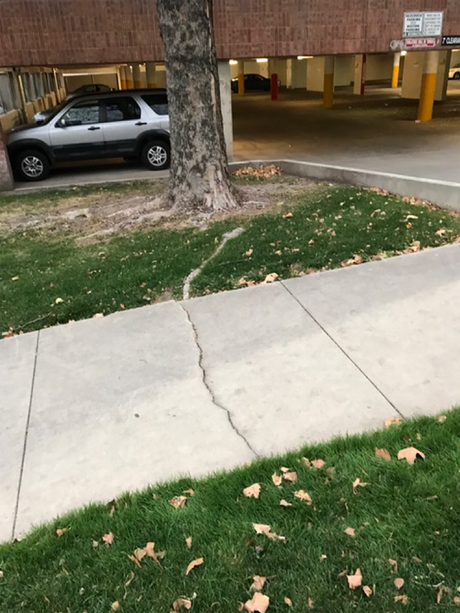
I was reminded of the power of small and simple things over time by something I saw on a morning walk. Here is the picture I took. The thick and strong concrete sidewalk is cracking. Is this the result of some large and powerful thrust? No, this cracking is caused by the slow, small growth of one of the roots reaching out from the adjoining tree. Here is a similar example I saw on another street.
Another crack in sidewalk
The thrusting power that cracked these heavy concrete sidewalks was too small to measure on a daily or even a monthly basis, but its effect over time was incredibly powerful.
So is the powerful effect over time of the small and simple things we are taught in the scriptures and by living prophets. Consider the scripture study we’ve been taught to incorporate into our daily lives. Or consider the personal prayers and the kneeling family prayers that are regular practices for faithful Latter-day Saints. Consider attendance at seminary for youth or institute classes for young adults. Though each of these practices may seem to be small and simple, over time they result in powerful spiritual uplift and growth. This occurs because each of these small and simple things invites the companionship of the Holy Ghost, the Testifier who enlightens us and guides us into truth, as President Eyring has explained.
Another source of spiritual uplift and growth is an ongoing practice of repenting, even of seemingly small transgressions. Our own inspired self-evaluations can help us see how we have fallen short and how we can do better. Such repentance should precede our weekly partaking of the sacrament. Some subjects to consider in this process of repentance are suggested in the hymn “Have I Done Any Good?”
Have I done any good in the world today?
Have I helped anyone in need?
Have I cheered up the sad and made someone feel glad?
If not, I have failed indeed.
Has anyone’s burden been lighter today
Because I was willing to share?
Have the sick and the weary been helped on their way?
When they needed my help was I there?2
Surely these are small things, but surely they are good examples of what Alma taught his son Helaman: “And the Lord God doth work by means to bring about his great and eternal purposes; and by very small means the Lord … bringeth about the salvation of many souls” (Alma 37:7).
President Steven C. Wheelwright gave an audience at Brigham Young University–Hawaii this inspired description of Alma’s teaching: “Alma confirms for his son that indeed the pattern the Lord follows when we exercise faith in Him and follow His counsel in small and simple things is that He blesses us with small daily miracles, and over time, with marvelous works.”3
President Howard W. Hunter taught that “frequently it is the commonplace tasks … that have the greatest positive effect on the lives of others, as compared with the things that the world so often relates to greatness.”4
A persuasive secular teaching of this same principle comes from former Senator Dan Coats of Indiana, who wrote: “The only preparation for that one profound decision which can change a life, or even a nation, is those hundreds and thousands of half-conscious, self-defining, seemingly insignificant decisions made in private.”5
Those “seemingly insignificant” private decisions include how we use our time, what we view on television and the internet, what we read, the art and music with which we surround ourselves at work and at home, what we seek for entertainment, and how we apply our commitment to be honest and truthful. Another seemingly small and simple thing is being civil and cheerful in our personal interactions.
None of these desirable small and simple things will lift us to great things unless they are practiced consistently and continuously. President Brigham Young was reported as saying: “Our lives are made up of little, simple circumstances that amount to a great deal when they are brought together, and sum up the whole life of the man or woman.”6
We are surrounded by media influences and cultural deteriorations that will carry us downstream in our values if we are not continually resisting. To move upstream toward our eternal goal, we must constantly keep paddling. It helps if we are part of a team that is paddling together, like a rowing crew in action. To extend that example even further, the cultural currents are so strong that if we ever stop paddling, we will be carried downstream toward a destination we do not seek but which becomes inevitable if we do not constantly try to move forward.
After reciting a seemingly small event that had great consequences, Nephi wrote, “And thus we see that by small means the Lord can bring about great things” (1 Nephi 16:29). The Old Testament includes a memorable example of this. There we read how the Israelites were plagued by fiery serpents. Many people died from their bites (see Numbers 21:6). When Moses prayed for relief, he was inspired to make “a serpent of brass, and put it upon a pole.” Then, “if a serpent had bitten any man, when he beheld the serpent of brass, he lived” (verse 9). Such a small thing for such a miraculous result! Yet, as Nephi explained when he taught this example to those who were rebelling against the Lord, even when the Lord had prepared a simple way by which they could be healed, “because of the simpleness of the way, or the easiness of it, there were many who perished” (1 Nephi 17:41).
That example and that teaching remind us that the simplicity of the way or the easiness of the commanded task cannot mean that it is unimportant to achieve our righteous desire.
Similarly, even small acts of disobedience or minor failures to follow righteous practices can draw us down toward an outcome we have been warned to avoid. The Word of Wisdom provides an example of this. Likely the effect on the body of one cigarette or one drink of alcohol or one dose of another drug cannot be measured. But over time, the effect is powerful and may be irreversible. Remember the cracking of the sidewalk by the gradual small expansions of the root of the tree. One thing is certain, the terrible consequences of partaking of anything that can become addictive, like drugs that attack our bodies or pornographic material that degrades our thoughts, is totally avoidable if we never partake for the first time—even once.
Many years ago, President M. Russell Ballard described to a general conference audience “how small and simple things can be negative and destructive to a person’s salvation.” He taught: “Like weak fibers that form a yarn, then a strand, and finally a rope, these small things combined together can become too strong to be broken. We must ever be aware of the power that the small and simple things can have in building spirituality,” he said. “At the same time, we must be aware that Satan will use small and simple things to lead us into despair and misery.”7
President Wheelwright gave a similar caution to his BYU–Hawaii audience: “It is in failing to do the small and simple things that faith wavers, miracles cease, and progress towards the Lord and His kingdom is first put on hold and then begins to unravel as seeking after the kingdom of God is replaced with more temporal pursuits and worldly ambitions.”8
To protect against the cumulative negative effects that are destructive to our spiritual progress, we need to follow the spiritual pattern of small and simple things. Elder David A. Bednar described this principle in a BYU Women’s Conference: “We can learn much about the nature and importance of this spiritual pattern from the technique of … dripping water onto the soil at very low rates,” in contrast to flooding or spraying large quantities of water where it may not be needed.
He explained: “The steady drips of water sink deep into the ground and provide a high moisture level in the soil wherein plants can flourish. In like manner, if you and I are focused and frequent in receiving consistent drops of spiritual nourishment, then gospel roots can sink deep into our soul, can become firmly established and grounded, and can produce extraordinary and delicious fruit.”
Continuing, he said, “The spiritual pattern of small and simple things bringing forth great things produces firmness and steadfastness, deepening devotion, and more complete conversion to the Lord Jesus Christ and His gospel.”9
The Prophet Joseph Smith taught this principle in words now included in the Doctrine and Covenants: “Let no man count them as small things; for there is much … pertaining to the saints, which depends upon these things” (D&C 123:15).
In connection with the earliest attempts to establish the Church in Missouri, the Lord counseled patience for “all things must come to pass in their time” (D&C 64:32). Then He gave this great teaching: “Wherefore, be not weary in well-doing, for ye are laying the foundation of a great work. And out of small things proceedeth that which is great” (D&C 64:33).
I believe we all desire to follow President Russell M. Nelson’s challenge to press forward “on the covenant path.”10 Our commitment to do so is strengthened by consistently following the “small things” we are taught by the gospel of Jesus Christ and the leaders of His Church. I testify of Him and invoke His blessings on all who seek to keep on His covenant path, in the name of Jesus Christ, amen.

Monday, May 14, 2018


Lesson Recap: May 13, 2018


"Spiritual Eclipse"
By Elder Gary E. Stevenson


On August 21 of this year, two rare events occurred that captured the attention of people around the world. The first was the 90th birthday celebration of our beloved prophet, President Thomas S. Monson. At the time, I was on assignment in the Pacific Area and was thrilled that the Saints of Australia, Vanuatu, New Zealand, and French Polynesia were not only aware of his personal milestone, but they also rejoiced in celebrating it. I felt fortunate to share in their warm expressions of faith and love for this great man. What an inspiration it is to see the connection Latter-day Saints share with their prophet.
Of course, President Monson, mindful of those desiring to wish him happy birthday, described an ideal birthday gift: “Find someone who is having a hard time or is ill or lonely and do something for them. That’s all I would ask.”1 We love and sustain you, President Monson.
Solar Eclipse
The other rare and heavenly event occurring on the same day and captivating millions worldwide was a total solar eclipse. This was the first time such an eclipse had marched across the entire United States in 99 years.2 Have you ever seen a solar eclipse? Perhaps I could describe this in greater detail.
A total solar eclipse occurs when the moon moves between the earth and the sun, almost completely blocking any light from the sun’s surface.3 The fact that this can happen is a marvel to me. If you imagine the sun as the size of a common bicycle tire, the moon in comparison would scarcely be the size of a small pebble.
Bicycle tire and pebble
How is it possible that the very source of our warmth, light, and life could be so greatly obscured by something comparatively insignificant in size?
Although the sun is 400 times larger than the moon, it is also 400 times farther away from the earth.4 From earth’s perspective, this geometry makes the sun and moon appear to be the same size. When the two are aligned just right, the moon seems to obscure the entire sun. Friends and family of mine who were in the zone of total eclipse described how light was replaced by darkness, the stars appeared, and birds quit singing. The air became chilly, as temperatures in an eclipse can decrease by more than 20 degrees Fahrenheit (11 degrees Celsius).5
They described a sense of awe, astonishment, and even anxiety, knowing an eclipse brings certain hazards. However, they all exercised care to prevent permanent eye damage or “eclipse blindness” during the eclipse event. Safety was made possible because they wore glasses equipped with special filtered lenses that protected their eyes from any potential harm.

The Analogy

In the same manner that the very small moon can block the magnificent sun, extinguishing its light and warmth, a spiritualeclipse can occur when we allow minor and troublesome obstructions—those we face in our daily lives—to get so close that they block out the magnitude, brightness, and warmth of the light of Jesus Christ and His gospel.
Elder Neal A. Maxwell took this analogy even further when he stated: “Even something as small as a man’s thumb, when held very near the eye, can blind him to the very large sun. Yet the sun is still there. Blindness is brought upon the man by himself. When we draw other things too close, placing them first, we obscure our vision of heaven.”6
Clearly, none of us wants to purposefully obscure our vision of heaven or allow a spiritual eclipse to occur in our lives. Let me share some thoughts that may assist us in preventing spiritual eclipse from causing us permanent spiritual damage.

Gospel Glasses: Maintain a Gospel Perspective

Do you recall my description of special eyewear used to protect those viewing a solar eclipse from eye damage or even eclipse blindness? Looking at a spiritual eclipse through the protecting and softening lens of the Spirit provides a gospel perspective, thus protecting us from spiritual blindness.
Let’s consider some examples. With the words of the prophets in our hearts and the Holy Spirit as our counselor, we can gaze at partially blocked heavenly light through “gospel glasses,” avoiding the harm of a spiritual eclipse.
So how do we put on gospel glasses? Here are some examples: Our gospel glasses inform us that the Lord desires that we partake of the sacrament each week and that He desires that we study the scriptures and have daily prayer. They also inform us that Satan will tempt us not to. We know that his agenda seeks to take away our agency through distractions and worldly temptations. Even in Job’s day, perhaps there were some experiencing a spiritual eclipse, described as: “They meet with darkness in the daytime, and grope in the noonday as in the night.”7
Brothers and sisters, when I speak of seeing through gospel glasses, please know that I am not suggesting that we do not acknowledge or discuss the challenges we face or that we walk blissfully ignorant of the traps and evils the enemy has placed before us. I am not speaking of wearing blinders—but just the opposite. I am suggesting that we look at challenges through the lens of the gospel. Elder Dallin H. Oaks observed that “perspective is the ability to see all relevant information in a meaningful relationship.”8 A gospel perspective expands our sight to an eternal view.
When you put on gospel glasses, you find enhanced perspective, focus, and vision in the way you think about your priorities, your problems, your temptations, and even your mistakes. You will see brighter light that you could not see without them.
Ironically, it is not only the negative that can cause spiritual eclipse in our lives. Often, admirable or positive endeavors to which we dedicate ourselves can be drawn so close that they blot out gospel light and bring darkness. These dangers or distractions could include education and prosperity, power and influence, ambition, even talents and gifts.
President Dieter F. Uchtdorf has taught that “any virtue when taken to an extreme can become a vice. … There comes a point where milestones can become millstones and ambitions, albatrosses around our necks.”9
Let me share in greater detail examples that could become catalysts for avoiding our own spiritual eclipses.

Social Media

A few months ago I spoke at BYU Women’s Conference.10 I described how technology, including social media, facilitates spreading “the knowledge of a Savior … throughout every nation, kindred, tongue, and people.”11 These technologies include Church websites like LDS.org and Mormon.org; mobile apps such as Gospel Library, Mormon Channel, LDS Tools, and Family Tree; and social media platforms, including Facebook, Instagram, Twitter, and Pinterest. These modalities have generated hundreds of millions of likes, shares, views, retweets, and pins and have become very effective and efficient in sharing the gospel with family, friends, and associates.
All of the virtues and appropriate use of these technologies notwithstanding, there are risks associated with them that, when drawn too close, can put us in a spiritual eclipse and potentially block the brightness and warmth of the gospel.
The use of social media, mobile apps, and games can be inordinately time-consuming and can reduce face-to-face interaction. This loss of personal conversation can affect marriages, take the place of valuable spiritual practices, and stifle the development of social skills, especially among youth.
Two additional risks related to social media are idealized reality and debilitating comparisons.
Many (if not most) of the pictures posted on social media tend to portray life at its very best—often unrealistically. We have all seen beautiful images of home decor, wonderful vacation spots, smiling selfies, elaborate food preparation, and seemingly unattainable body images.
Here, for example, is an image that you might see on someone’s social media account. However, it doesn’t quite capture the full picture of what is actually going on in real life.
Comparing our own seemingly average existence with others’ well-edited, perfectly crafted lives as represented on social media may leave us with feelings of discouragement, envy, and even failure.
One person who has shared numerous posts of her own said, perhaps only partly in jest, “What’s the point of being happy if you’re not going to post it?”12
As Sister Bonnie L. Oscarson reminded us this morning, success in life doesn’t come down to how many likes we get or how many social media friends or followers we have. It does, however, have something to do with meaningfully connecting with others and adding light to their lives.
Hopefully, we can learn to be more real, find more humor, and experience less discouragement when confronted with images that may portray idealized reality and that too often lead to debilitating comparisons.
Comparison apparently is not just a sign of our times but was in times past as well. The Apostle Paul warned the people of his day that “they measuring themselves by themselves, and comparing themselves among themselves, are not wise.”13
With so many appropriate and inspired uses of technology, let us use it to teach, inspire, and lift ourselves and to encourage others to become their finest—rather than to portray our idealized virtual selves. Let us also teach and demonstrate the righteous use of technology to the rising generation and warn against the associated hazards and destructive use of it. Viewing social media through the lens of the gospel can prevent it from becoming a spiritual eclipse in our lives.

Pride

Let’s now address the age-old stumbling block of pride. Pride is the opposite of humility, which is a “willingness to submit to the will of the Lord.”14 When prideful, we tend to take honor to ourselves rather than giving it to others, including the Lord. Pride is often competitive; it is a tendency to seek to obtain more and presume we are better than others. Pride often results in feelings of anger and hatred; it causes one to hold grudges or to withhold forgiveness. Pride, however, can be swallowed in the Christlike attribute of humility.
Relationships, even with close family and loved ones, especiallywith close family and loved ones—even between husbands and wives—are fostered in humility and are stymied by pride.
Many years ago an executive of a large retailer called me to talk about his company, which was being bought out by one of its competitors. He and numerous other headquarters personnel were extremely anxious that they might lose their jobs. Knowing that I was well acquainted with senior management of the acquiring company, he asked if I would be willing to both introduce him and give a strong reference on his behalf, even to arrange a meeting for him. He then concluded with the following statement: “You know what they say? ‘The meek shall perish!’”
I understood his comment was more than likely intended as humor. I got the joke. But there was an important principle that I felt might ultimately be of use to him. I replied, “Actually, that isn’t what they say. In fact, it is just the opposite. ‘The meek … shall inherit the earth’15 is what they say.”
In my experience in the Church as well as throughout my professional career, some of the greatest, most effective people I have known have been among the most meek and humble.
Humility and meekness fit hand in glove. May we remember that “none is acceptable before God, save the meek and lowly in heart.”16
I pray that we will strive to avoid the spiritual eclipse of pride by embracing the virtue of humility.

Conclusion

In conclusion, a solar eclipse is indeed a remarkable phenomenon of nature during which the beauty, warmth, and light of the sun can be completely covered by a comparatively insignificant object, causing darkness and chill.
A similar phenomenon can be replicated in a spiritual sense, when otherwise small and insignificant matters are drawn too close and block the beauty, warmth, and heavenly light of the gospel of Jesus Christ, replacing it with cold darkness.
Eyewear designed to protect the sight of those in the zone of a total solar eclipse can prevent permanent damage and even blindness.17 Gospel glasses comprised of a knowledge and testimony of gospel principles and ordinances provide a gospel perspective that can similarly provide greater spiritual protection and clarity for someone exposed to the hazards of a spiritual eclipse.
If you discover anything that seems to be blocking the light and joy of the gospel in your life, I invite you to place it in a gospel perspective. Look through a gospel lens and be vigilant not to allow insignificant and inconsequential matters in life to obscure your eternal view of the great plan of happiness. In short, don’t let life’s distractions eclipse heaven’s light.

Testimony

I bear testimony that no matter the obstruction that may block our vision of gospel light, the light is still there. That source of warmth, truth, and brightness is the gospel of Jesus Christ. I bear testimony of a loving Heavenly Father; of His Son, Jesus Christ; and of the Son’s role as our Savior and Redeemer. In the name of Jesus Christ, amen.